Thursday, November 13, 2008

Gift from the Flowers


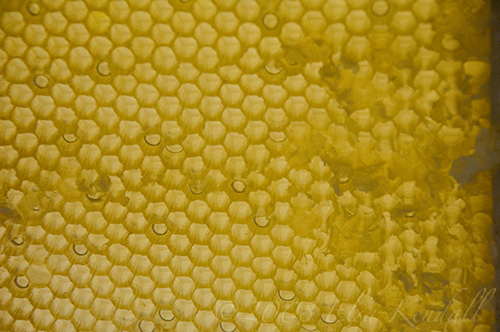
What you are seeing here is nectar from thousands and thousands of flowers, collected from hundreds of bees then miraculously turned into honey and stored in perfect wax canisters called honeycomb. Amazing. 
From my friend Tom's hive during a honey harvest in August.

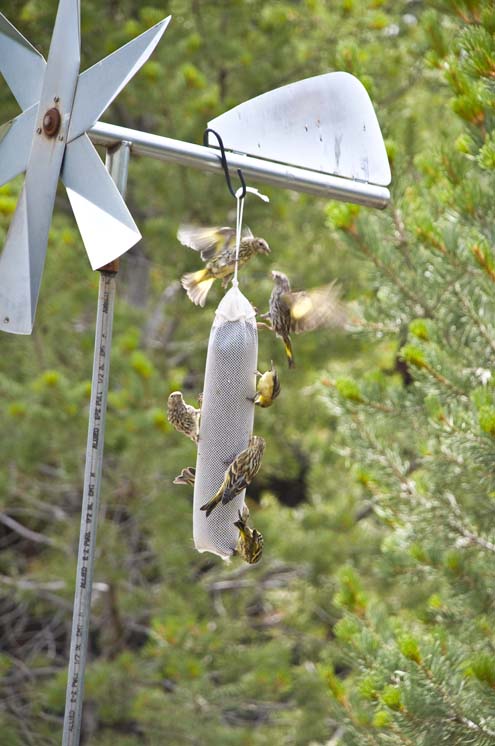
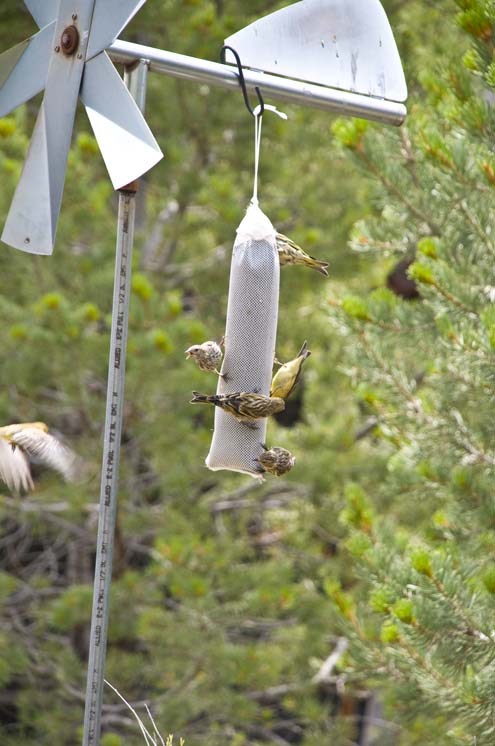
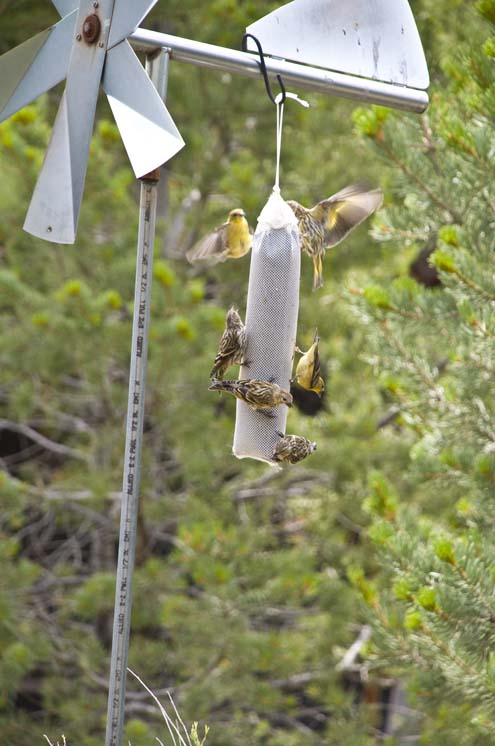
Lesser Goldfinches Hold Their Own with the Siskins


Sunday, November 9, 2008

Season of Mists and Mellow Fruitfulness


Season of mists and mello fruitfulness,
Close bosom-friend of the maturing sun;
Conspiring with him how to load and bless
With fruit the vines that round the thatch-eaves run;
To bend with apples the moss'd cottage-trees;
And fill all fruit with ripeness to the core;
To swell the gourd, and plump the hazel shells
With a sweet kernel; to set budding more,
And still more, later flowers for the bees,
Until they think warm days will never cease,
For Summer has o'er-brimm'd their clammy cells.

Who hath not seen thee oft amid thy store?
Sometimes whoever seeks abroad may find
Thee sitting careless on a granary floor,
Thy hair soft-lifted by the winnowing wind;
Or on a half-reap'd furrow sound asleep,
Drowsed with the fume of poppies, while thy hook
Spares the next swath and all its twined flowers:
And sometimes like a gleaner thou dost keep
Steady thy laden head across a brook;
Or by a cider-press, with patient look,
Thou watchest the last oozings, hours by hours. 

—John Keats, Ode to Autumn


These are the first two verses from one of my favorite poems. I learned it in school as a young teenager in England; sounded to my ears for the first time by Mr. Evans, my baritone English teacher who happened to be Welsh. There are not too many I remember but Keats was one of my favorites. He lived for a brief time in the literature paradise of Hampstead Heath which is not too far from the county in which I grew up, Hertfordshire. Last summer I visited Keats's house on the heath. He was of very modest means and rented it for a time before his tuberculosis became so acute he moved to Rome for the warmer, dryer climate. A few years ago I had seen the home he occupied there, above the Spanish steps of the Piazza di Spagna, which contained one of the tiniest and most lovely shops I'd ever seen, selling just gloves. Luscious.

I found this poem in an old letterpress dual-volume I bought here in Santa Fe. Inside the front cover lays a book label with a crest which reads in Spanish, Honor is my guide. The name on the crest is Frederic Perry Lousada of Her Majesty's 84th Regiment, which seemed to have been formed from the Royal Highland Immigrants' regiment during the war between the British and the Colonials in 1775; and was known as the 84 Regiment on Foot. Through additional searching I see Lousada may have lived circa 1858, not forty years after John Keats' passing. This book was published in 1904, so perhaps he enjoyed it as a retired gentleman soldier. How the books came to be in Santa Fe remains a mystery.

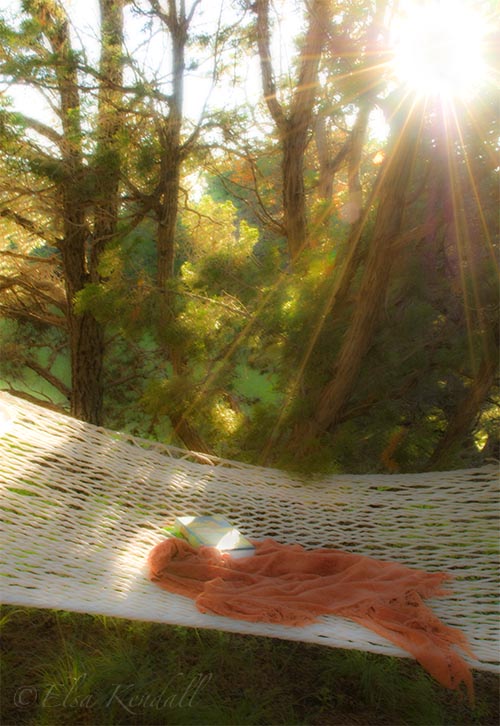
Time to collect the seeds and put away the hammock~


Sunday, November 2, 2008

Autumn Sunday Afternoon With Parlez


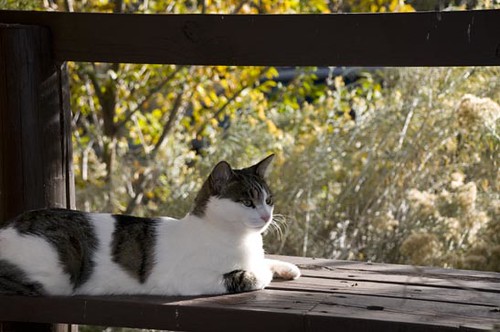
Ah, nothing like a nice reposé on Sunday afternoon.
Warm sun, golden aspen leaves and the perfect place for bird watching.


But what's this? Mama with that box again. I think I'll just sit here looking alert but nonchalant.


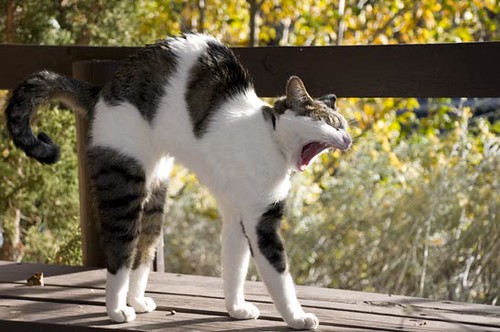
We cats can only do that for so long. Time to stretch and see what's happening elsewhere.


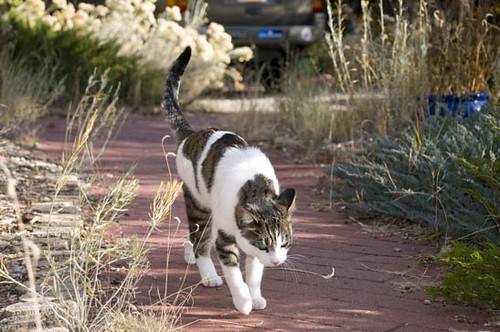
Adios amigos. Until the next time. . . 

Wednesday, October 29, 2008

Popping Forth Those Pinon Seeds


We have had a bumper crop of pinon seeds this year. The big pinon jays have been gorging themselves, and no doubt hiding a few as well. A friend shared with me their beaks are the perfect length for planting. They will bury a seed near a mature pinon tree, in its shade, at exactly the perfect depth. It will grow as the sheltering tree ages, and when it's time the seedling will have matured to take its place. Now isn't that a marvel?

For me, these seeds are the most beautiful nuggets of burnished copper brown that I wish I could string on a necklace. I've been collecting them to make a collage. Sweetie often passes the bowl wistfully, "Are you sure I can't just eat these?"  No, not yet. :-)

Saturday, October 25, 2008

Close Up


This morning I came in to my work room and thought about turning on the computer. Parlez was lounging in a sun beam on top of my folders, notes and papers. I greeted him and he looked over at me squinting and said, "Mama, you're not going to work today are you? It's so beautiful today and autumn is at its height. You really should be outside." I grabbed the camera and he stuck his nose into the lens, trying to see if there was anything appetizing. Nope. No mouse. No kangaroo rat (a gift last night). No mountain beaver. And the lizards are gone for the year. Well, I guess I'm going to quit this taco stand and see what's going on outside. And with that he jumped down and scooted out of his kitty door. If you click on this photo you will see a very persuasive cat telling you to go outside and have some fun. Go on. Try it. :~)

Tuesday, October 21, 2008

Gift from a Squirrel


Last winter I was feeding the birds a mix of yummy seeds, mostly sunflower. I didn't see many squirrels because Parlez was on the scene, newly arrived, and keeping guard. Several months later I was out on the rebounder trampoline and I noticed a couple of sunflowers energetically sprouting out of a neglected pot. I wondered how they got there, as I hadn't planted them. And then I realized a squirrel must have stashed them for the winter where they had lain dormant and unclaimed until now.

Later in the summer as they grew and bloomed, one attracting the most amazing fluorescent green fly, I studied it and the pattern of the zillions of yellow petals. Remembering the Italian for sunflower, girasole—literally meaning to circle or follow the sun—I was transported back to dozing on a train through Tuscany and awakening at the precise moment we were running along fields and fields of sunflowers in full bloom. It was so beautiful, all that yellow warming the countryside. Now, out of my reverie, I marveled at how one seed planted by a squirrel could turn into such a beautiful flower. And that one flower could create so many more seeds to make many, many more flowers. I think of this now at harvest time, the gift of seeds.

Summer passed and I saw this one above, spent, getting ready to shed its seeds for another batch of beauties the following year. That same day I went for a walk in the arroyo. It was the chamisa's turn for center stage, the sunflowers had all gone. Or so I thought. Walking in the fall sunshine I was contemplating the quality of grace. Startled I heard what sounded like a pack of barking dogs. I looked in their direction and saw none, but instead one stellar, golden sunflower perched all alone on the edge of the arroyo. Sitting about two feet tall it looked down over to me, smiling and waving. Grace.

Friday, October 17, 2008

Headline News: Morning Glory Climbs Avocado


Beauty is not a luxury but a strategy for survival. —Terry Tempest Williams

I've been watching this little seed sprout for the last several weeks and little by little it has found its way up an avocado we've been growing from seed. I added some soil to the top of this pot and there must have been one little morning glory seed in it. I can't wait to see what color it is. Heart upon heart ascends; it knows the way. 

Monday, October 13, 2008

Take a Walk With Me Through Aspen Vista


I've seen a lot of cathedrals in my life, but this is my favorite. Last week, after the first snow in the mountains miraculously the aspen leaves remained on the trees. What glory is was to be up at 9,000 feet among this beauty. Yellow and blue. Golden and Hue. 

Sunday, October 12, 2008

Me and My Shadow


And sometimes my shadow comes through the tall grass with gifts. 
This little one I couldn't let go of for a long time.

Friday, October 10, 2008

Those Amazing Ants Are At It Again...


The amazing ants are at it again. I walk carefully down the path, always being aware of their industry. This particular morning I had to squat down and take a good look at these feathers, courtesy of the pine siskins, courtesy perhaps of Parlez. Sigh. He would wait behind a flower pot and when these happily fed birds flew by below six feet, he'd jump up with his mouth open and presto, sometimes he'd catch one. Sometimes some feathers fluttered, and that was good fortune for the ants. They did manage to get both of these down their front door. It took about a day. But they did it. 

Why? I have no idea. Just part of the great Mystery.

Another type of blue view

Ahhh.

Sometimes, when the computer just hammers up your head, when you let it, as I do often, it's nice to just go outside and smell the roses. Or notice the heavenly blue morning glories! We are in the midst of early fall blue skies and still warm sun. These little beauties are still going. They are just yummy.

Saturday, October 4, 2008

Butterflies are free


The Painted Lady butterfly. 
Hundreds of these little gems are flocking to the chamisa to supp on the last beads of nectar before the first frost comes. Their bodies look as though they are made of gold dust. What a delight they've been.


This year, unlike any other in the 13 years I've lived in New Mexico, is full of hundreds upon hundreds of painted ladies. Recently I was walking down the arroyo amidst a vast avenue of chamisa bushes. All around me these magnificent creatures were flying and lighting on the blooms, dipping their proboscis into them and sipping nectar. One bush had at least 50 butterflies drinking from it, and when I approached on tip toes they caught site of me and elevated into the air all at once. What a wonder. I once heard of a man who said the collective flap of butterflies' wings could create a hurricane. 23 million Monarchs gather in Mexico so I would imagine all of them lifting at once could indeed create some energy. For more on this theory click here

Regardless of whether it's true or not, just the idea of this movement and how it impacts the earth is a mighty fine thing to ponder. Such fragility and strength, all in one tiny being; a being that actually tastes with the front of its legs! Walking in the arroyo I watched the ladies and then I wondered what the difference was between these, and Monarchs. Just then an orange and black butterfly, twice the size and with double wings flew by. Wonder and ye shall receive. :-)

This is the story of the geneology of the monarch butterfly and the amazing journey they make each year, which I lifted from the World Wildlife Organization's website, here


The Monarch of Migration
The Monarch butterfly is known by scientists as Danaus plexippus, which in Greek literally means "sleepy transformation." The name, which evokes the species' ability to hibernate and metamorphize, is actually inspired by the Greek myth of Danaus, in which the daughters of Danaus, king of Libya, flee Libya for Greece in order to avoid marrying their cousins. The long, migratory journey of the Monarch butterflies is reminiscent of the daughters' flight.

Adult Monarchs possess two pair of brilliant orange-reddish wings, featuring black veins and white spots along the edges. Their wingspan is about four inches, and they weigh less than half an ounce. Males, who possess distinguishing black dot (stigmata) along the veins of their wings, are slightly bigger than the females.

Each adult butterfly lives only about four to five weeks. But one of the many wonders of the Monarchs is the annual creation of a unique "Methuselah generation." As autumn approaches in their sites of migratory origin, a very special generation of butterflies is born. Unlike their parents, grandparents, great-grandparents, and great-great-grandparents -- all of whom had ephemeral lives measured only in weeks -- these migratory butterflies survive seven or eight months. In human terms, given our average life span of 75 years, this would be like having children who lived to be 525 years old!

This generation performs the incredible feat of flying from Canada and the United States to the center of Mexico -- after which they begin the northward journey again. Once they reach the United States, a kind of relay race begins: their short-lived offspring, with only four or five weeks to live, continue making the trek northward over several generations.

Of all migrations by small creatures, few are as astonishing as the one performed by the Monarch butterfly. The embodiment of fragility, these insects travel between 1,200 and 2,800 miles or more between their starting and ending points -- a feat without parallel. What is even more remarkable is that the ones that return to the places where Monarchs hibernate have never been there before. These are the great-great-great-grandchildren of those that performed the intrepid journey from southeast Canada and the United States to central Mexico.

Like several species of birds, bats and whales, the Monarch butterfly of Canada and the United States migrates to places where the climate is less extreme. Winters are too cold in the places where the butterflies reproduce; Monarchs would not be able to withstand either heavy snowfall or the lack of plants on which larval caterpillars feed. As such, the Monarch heads south each fall, where it will stand a greater chance of survival-as well as the chance to "return" to reproductive sites in North America and give rise to future generations of reproductive adults that will complete the annual cycle.

The Monarch butterflies that migrate southward in the autumn are guided by the sun's orbit as they travel through North America. Even on cloudy days they stay on track thanks to an internal biological compass that functions according to the movement of the sun.

The migration moves at a pace of about almost 50 miles a day, though there are some butterflies that have flown up to 80 miles in a day. Throughout the migration, they continue to store and replenish energy each day by extracting nectar from flowers they encounter along the way. But the butterflies also suffer from illnesses and infections that can be fatal, and must face other dangers including bad weather, predation by birds during hibernation, and big losses in the population due to winter storms.

At the end of October and the beginning of November, after traveling two months, the butterflies settle into hibernation colonies in the mountains of central Mexico, where the States of Mexico and Michoacan meet. There they will spend the winter hibernating.

From mid-November until mid-February, the Monarchs' hibernation colonies remain relatively stable. During the second half of February, when temperatures rise and humidity decreases in the forests, the butterflies come down from the slopes to mate. And the butterflies that survive the hibernation in Mexico return in the spring to the southern United States.


Perhaps these magnificent creatures have come here to symbolize our own transformation and a call to the dance of joy, even in these uncertain times. 

Thursday, September 25, 2008

The Law of Love and the Law of Violence


In July I began reading Jean Giono's The Solitude of Compassion and noticed Henry Miller had written the introduction. Within it he included an excerpt from Tolstoy written close to 100 years ago. I was stunned by what he said, and realized just how significant his voice is for us now. The words below were written at the end of his days, where it seems he had many years to come to understand how information, knowledge, and wisdom evolve.


"This then is everything that I would like to say: I would say to you that we are living in an age and under conditions that cannot last, and that, come what may, we are obliged to choose a new path. And in order to follow it, it is not necessary for us to invent a new religion nor to discover new scientific theories in order to explain the meaning of life or art as a guide. Above all it is useless to turn back again to some special activity; it is necessary to adopt one course alone to free ourselves from the superstitions of false Christianity and of state rule.

Let each one realize that he has no right, nor even the possibility, to organize the life of others; that he should lead his own life according to the supreme religious law revealed to him, and as soon as he had done this, the present order will disappear; the order that now reigns among the so-called Christian nations, the order that has caused the world to suffer, that conforms so little to the voice of conscience and that renders humanity more miserable every day. Whatever you are: ruler, judge, landlord, worker, or tramp, reflect and have pity on your soul. No matter how clouded your brain has become through power, authority and riches, no matter how maltreated and harassed you are by poverty and humiliation, remember that you possess and manifest, as we all do, a divine spirit which now asks clearly: Why do you martyrize yourself and cause suffering to everyone with whom you come in contact?

Understand, rather, who you really are, how truly insignificant and vulnerable is the being you call you, and which you recognize in your own shape, and to what extent, on the contrary, the real you is immeasurably your spiritual self—and having understood this, begin to live each moment to accomplish your true mission in life revealed to you by a universal wisdom, the teachings of Christ, and your own conscience. Put the best of yourself into increasing the emancipation of your spirit from the illusions of the flesh and into love of your neighbor, which is one and the same thing. As soon as you begin to live this way you will experience the joyous feeling of liberty and well-being. You will be surprised to find that the same exterior objectives which preoccupied you and which were far from realization, will no longer stand in the way of your greatest possible happiness. And if you are unhappy—I know you are unhappy—ponder upon what I have stated here. It is not merely imagined by me but is the result of the reflections and beliefs of the most enlightened human hearts and spirits; therefore, realize that this is the one and only way to free yourself from your unhappiness and to discover the greatest possible good that life can offer. This then is what I would like to say to my bothers, before I die."

—Leo Tolstoy, The Law of Love and the Law of Violence circa 1909

Monday, September 22, 2008

Wild Heart: Seeing Red? See Blue Instead

I've been looking a lot at the flowers that surround the area in which I live. Most recently I caught site of the morning glories who are in their last throes of bloom. I noticed this: when they first sprout out of the seed their tiny leaves are in the shape of a butterfly. Gradually this butterfly changes shape and becomes a heart. I made several photos of these clustered together in a pot, but just couldn't get the images I wanted. A few days passed. I went outside and sat quietly. Looking to my right behold: a wee adventurer sprouting away from the others: A perfect heart.


About the same time I came upon another interview with Terry Tempest Williams on New Dimensions Radio. I downloaded it and have been enjoying her thoughts from 1994 where she spoke to, "the passion that we feel is naturally translated to a politics of place—standing our ground in the places that we love." Perhaps these places aren't only geographical. Wild Heart: The Politics of Place is the name of the segment and it can be found here. And here I share with you a few words which seem very appropriate for these times of great turmoil, but also of great awakening and change.

"If we lose our connection to the landscape, if we forget where the source of our power lies—our real power—not the power in Washington, not power based on oppression, but power based from an authentic life, from a life in balance, from a life of beauty, awe, integrity, compassion, empathy; then how can we know liberty? How can we know the truth of our souls? How can we know other?"

I have felt the vibration of my own aggravation being reflected out to and joining with others, as many of us are appalled at some of the choices that have been made in the last few weeks during the presidential campaign. This is a whole post unto itself, but what came through several days ago was a real understanding (I had been petitioning for one) of needing to "Be the change you want to see in the world (Ghandi). I knew my seeing red was not going to serve myself or anyone else and so I made a conscious choice to acknowledge the agitation and anger, and then move away from it and focus on seeing blue instead. This was such a a relief! The negativity of anger, flight or fight, fear, warring, and oppression was replaced by the cool hue of blue: vision, compassion, calm, higher viewpoint, inspiration and hope. 

My feeling is that as I hold this state of consciousness it will create a vibration, as it must according to the laws of nature. And this vibration will then be imprinted upon the ethers, as again it must. And I saw others holding this intention as well, releasing the red and imbuing the blue. Gone was the vision I had of angry hornets swarming across the country. And in its place I saw the most glorious thing: she bees, honey bee workers, females; all in harmony, working with ease and cooperation, creating a sweet vibration permeating the ethers, wafting from flower to flower, hive to hive, garden to garden, street to street, town to town, state to state, coast to coast, and beyond.

And it was a very lovely thing indeed. And entirely possible. And very likely. Then Ghandi whispered to me across the blue, Be the change you want to see in the world, yes. But also, See the change you want to be in the world

Tuesday, September 16, 2008

A Walk in the Garden, Last Days of Summer


My fellow earth dwellers,

I'm bug eyed from looking at blogs and pages of you know what, and you know who. The natural world is such an antidote to this senseless stress and thank goodness we have it still. These little shots I made one morning last week as I walked around examining the new fuzzy caterpillars that are busy munching for their cocooning, and lots of flowers like Cosmos and Morning Glory and Sunflower that have finished their souljourns and have prepared some amazing seeds for next year. It never ceases to amaze me how one seed makes one plant, which makes many seeds—many, many if you are a sunflower.

Another Terry Tempest Williams treat on the way soon but in the meantime take a little stroll through this garden of earthly delights. Parlez joined in and thought it great fun to try and eat my camera strap while I made a photo of him. He was laying down taking a break after an arduous session waiting for finches to drop into his mouth, as you can see below.


Monday, September 8, 2008

The Garden of Earthly Delights


The Garden of Earthly Delights by Hieronymus Bosch (c. mid 15th century)


This morning as I bounced up and down on the ReBoundAir I immersed myself in a broadcast with Terry Tempest Williams which was recorded with Michael Toms on New Dimensions Radio. It's a wonderful interview made a little over eight years ago regarding her then new book, Leap, which was inspired by this amazing painting above. The $1.99 I paid for this download a while back has given me more inspiration than I can say. With the amazing iPod (or on your computer) one can revisit it often, and I do, and there is always a new morsel of wonder to be had.

Here is the information on this broadcast, THE TRANSFORMATIVE POWER OF ART, made in June of 2000. You can learn more about Terry, listen to it or download it here. You can also listen to a free snippet by creating an account with their site; a very rich resource brought to us by the amazing World Wide Web, upon which you are now perched. (!)

There are 45 different birds in Bosch's painting and Terry recounts how she had been bird watching behind the Prado during one visit, and took her binocs into the museum to sit and watch the birds in his painting. :)  Leap is well worth a read and there is a fold-out of the painting at the back for reference. 

The first time Terry Tempest Williams looked upon Hieronymus Bosch's painting, "The Garden of Earthly Delights," it captivated her spirit—and didn't let her go until she had walked a seven year pilgrimage through the multiple dimensions of the painting—a painting that remains as mysterious and provacative as it was five hundred years ago. The masterpiece spoke to Williams and she returns the favor eloquently—weaving together the spiritual, psychological, religious, ecological, and emotional intensity of a work of art that transformed her life. "Bosch's genius was saying, there is a real world, a beautiful world, an ambiguous world, a world of discovery and curiosity that is the center panel, the middle path."

In-joy~


Thursday, September 4, 2008

Manahmanah


Guaranteed to make your smile.

Unless perhaps you're Oscar.
;-)


The Internet Sherpa Led Me to This: Desiderata


An Inner Landscape, Oil pastel on terra cotta


The Internet Sherpa (who shall remain a mystery for the moment) led me to this, which led me to this piece of writing by Max Ehrmann, a poet and lawyer, from the 1920s. It came from his inspired urge "I should like, if I could, to leave a humble gift—a bit of chaste prose that had caught up some noble moods".

You can find out more about it here. It seems to be one of those timeless pieces of prose, just as applicable now as when he wrote it. 


DESIDERATA

Go placidly amid the noise and haste and remember what peace there may be in silence. As far as possible without surrender be on good terms with all persons. Speak your truth quietly and clearly; and listen to others, even the dull and ignorant; they too have their story.

Avoid loud and aggressive persons, they are vexations to the spirit. If you compare yourself with others, you may become vain and bitter; for always there will be greater and lesser persons than yourself. Enjoy your achievements as well as your plans.

Keep interested in your own career, however humble; it is a real possession in the changing fortunes of time. Exercise caution in your business affairs; for the world is full of trickery. But let this not blind you to what virtue there is; many persons strive for high ideals; and everywhere life is full of heroism.

Be yourself. Especially, do not feign affection. Neither be cynical about love; for in the face of all aridity and disenchantment it is perennial as the grass.

Take kindly the counsel of the years, gracefully surrendering the things of youth. Nurture strength of spirit to shield you in sudden misfortune. But do not distress yourself with imaginings. Many fears are born of fatigue and loneliness. Beyond a wholesome discipline, be gentle with yourself.

You are a child of the universe, no less than the trees and the stars; you have a right to be here. And whether or not it is clear to you, no doubt the universe is unfolding as it should.

Therefore, be at peace with God, whatever you conceive Him to be, and whatever your labors and aspirations, in the noisy confusion of life keep peace with your soul.

With all its sham, drudgery and broken dreams, it is still a beautiful world. Be careful. Strive to be happy.

Monday, September 1, 2008

Last Days of Summer


If you ever get to Lake Como...


I would highly recommend this beautiful hotel in Varenna. The Hotel Royal Victoria is situated across the lake from busier Bellagio and is one of the few hotels with a pool, thus making it a 4 star. This was my view from the small verandah where I ate breakfast most of the week I was there. And yes, the lake really is that blue. These two magnificent cypress trees framed the view from my modest and comfy room, with Bellagio right between them. Getting around is by ferry and you can travel from one 'town' to another this way most of the summer. All around you is flora and fauna, blue water, mountainettes of deciduous and coniferous trees, and some beautiful gardens. 

Varenna is known as the pearl of the lake, and it was indeed very lovely, quieter than other towns, with a castle at its highest point (a nice hike up I took one day to walk off the PASTA and GELATTO!). The lake is situated at the base of the Alps in northern Italy. It's easy to see why people have been drawn to it for centuries.